

The HVAC Service Manager Playbook 4.0
Last updated:
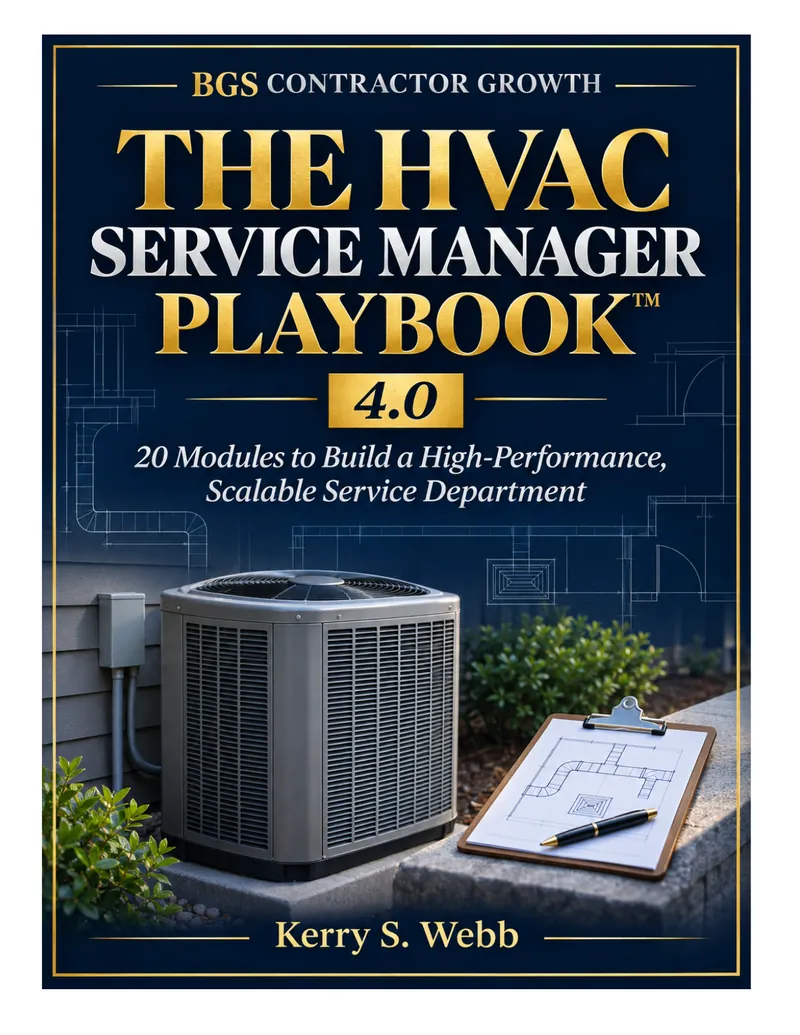
The HVAC Service Manager Playbook 4.0 is a written playbook for the person who runs your HVAC service department. Its 20 modules cover KPIs, technician scorecards, ride-along coaching, daily huddles, dispatch, pricing, callbacks, hiring and scaling. Each one comes with field scenarios, scorecards, scripts, practice drills and a plan for today, this week and this month.
Written by Kerry S. Webb. The cover puts the aim plainly: 20 modules to build a high-performance, scalable service department.
Price: $249
Buying online needs JavaScript turned on. You can also order The HVAC Service Manager Playbook 4.0 through the contact page.
01 / The problem
When the Board Is Full and Nothing Gets Better
The service department can be busy all day and still not improve. Calls get run, the board gets filled, the phone gets answered, and the same gaps show up again next week: low tickets, missed memberships, discounts nobody needed to give, callbacks.
The book's opening module names the trap. Filling the board and solving the problem in front of you are part of the job, but they can take all of a manager's attention. When they do, the manager spends the day reacting, and the technicians never get better.
This playbook is about the other half of the job: setting clear standards, watching the numbers, and coaching the technicians who do the work the customer sees.
02 / What is inside
What Is Inside The HVAC Service Manager Playbook 4.0
Twenty modules, in the order the book runs them. Every module follows the same pattern: the outcome it is after, scenarios from the field, the scorecards and trackers to use, the words to say, practice and role-play, and an action plan for today, this week and this month.
Module 1, Service Manager Identity
The shift from dispatcher to performance leader. A daily manager dashboard, a weekly technician scorecard and a daily coaching routine.
Module 2, KPI Mastery
Which numbers drive revenue and how to read them: calls, conversion, average ticket, revenue per call and memberships, with plain definitions so nothing gets counted twice.
Module 3, Technician Scorecards
A weekly scorecard on five measures, a grading scale and a 15-minute one-on-one review, so every technician knows where they stand.
Module 4, Ride-Along Coaching System
How to ride with a technician without taking over the call, a six-part ride-along scorecard, and how to debrief right after the call.
Module 5, Option Building Framework
The book's Good, Better, Best approach to giving the customer clear choices, built from a complete diagnosis, with a tracker for who is presenting options.
Module 6, Customer Communication
Teaching technicians to explain what a part does, what went wrong and why it matters, in plain language, with a communication scorecard.
Module 7, Maintenance Agreement System
Making the maintenance offer on every suitable call, tracking offers separately from sales, and explaining the plan without promising it prevents every breakdown.
Module 8, Daily Huddles
A morning huddle kept within 15 minutes, with a timed agenda: recognition, yesterday's numbers, today's targets, one focus topic and a send-off.
Module 9, Weekly Performance Reviews
A 15 to 20 minute weekly review for each technician: wins, gaps, the cause, and one or two things to work on before next week.
Module 10, Dispatch Optimization
Matching technicians to calls by skill as well as availability, with call types, technician profiles and a daily dispatch tracker.
Module 11, Call Conversion Strategy
Coaching the conversation on the call, from explaining the problem to asking which option the customer wants and handling "I need to think about it".
Module 12, Pricing Confidence
Helping technicians present a price and answer price objections, so the department can reduce unnecessary discounting, with a discount tracker.
Module 13, Callback Reduction
Logging every callback with its root cause, sorting causes into diagnosis, communication or work quality, and checking the work before a call is closed.
Module 14, Technician Recruiting Profile
Hiring for communication, coachability and sales aptitude as well as technical skill, with a candidate scorecard, interview questions, a role-play and a 30-day scorecard.
Module 15, Training Culture
A weekly training session of 30 to 60 minutes on one topic, with teaching, demonstration, role-play and follow-up in the field.
Module 16, Revenue Per Call Strategy
Looking at the whole system on every suitable call, not just the failed part, and explaining only the extra work the findings support.
Module 17, Leadership Communication
Stating standards clearly and calmly, having the hard conversation instead of avoiding it, and recognizing good work, with a manager self-evaluation.
Module 18, Performance Accountability
Holding technicians to what they can control, with an accountability tracker for results and a behavior tracker for the process.
Module 19, Data-Driven Decisions
Using daily dashboards to find the real cause before acting, so a slow-looking day or a revenue dip gets the right fix.
Module 20, Scaling the Service Department
Making the routines repeatable across people and branches, with a branch dashboard and a check on which systems are actually in use.
The book is 57 pages. The scorecards, trackers, dashboards, grading scales and hiring guide sit inside the modules where they are used, and every module ends with practice drills and a today, this week, this month plan. The book uses sample targets and worked dollar examples to teach, and it says plainly that they are examples: you set targets that fit your own department. It is HVAC throughout, written to the service manager. It does not cover installation, project management or accounting.
03 / How a team runs it
How a Service Manager Puts It to Work
The book's own instruction is short: work through the modules, apply the actions in your department, and review the results with your team.
Start with the numbers
The first modules set up a morning review of yesterday's results, a daily dashboard and a weekly scorecard for each technician.
Take one module's plan at a time
Every module ends with one thing to do today, a few things this week and a routine to build this month.
Build the weekly rhythm
A short huddle every morning, a weekly one-on-one with each technician, a weekly training session and regular ride-alongs.
Practice before the field
Each module has drills and role-plays, often with the manager playing the customer, so the new words get said out loud before they get said in a living room.
Review and adjust
Compare the results with the targets each week, find the cause behind a weak number, and coach that behavior.

The HVAC Service Manager Playbook 4.0, Module 1The technicians do the work that customers experience; your role is to help them do it better.
04 / Why it pays
Why Running It This Way Matters
A busy day can hide a weak result. The book's case is that the money in a service department is decided call by call: whether the technician explained the problem, offered real choices, made the maintenance offer, held the price and finished the job right the first time.
Read moreShow less
Those are things a manager can see, measure and coach. Small habits repeated every day, like a quick discount or a skipped check before closing a call, add up across a year. The book's dollar figures are worked examples to show why, not promises, and your own numbers will tell you where your department stands.
05 / Who it is for
Who Buys This and Who Uses It
You buy it. The person who runs your HVAC service department uses it. The book is written to the service manager from the first page: your job is to improve how your technicians perform.
If you run more than one location, the last module is about keeping the same standards, numbers and routines across branches. If you are still running service yourself, the book is written to whoever holds that job, and that includes you.
06 / Pairs with
What It Pairs With
This book is written from the manager's seat. Your technicians need their own standard for the call, and your manager needs something to coach them against.
The Customer's CHOICE Service Call Playbook is written for the technicians this book has your manager coach, with its own manager checks and a manager ride-along review, and it hands replacement conversations on to the CHOOSE2 Sales Training Playbook.
-
Training program
CSR Booking Excellence Playbook
For the people who answer your phone and book your calls.
-
Scripts and checklists
CSR Call Scripts & CRM Mastery
Call scripts and CRM tasks for the people on your phones.
-
Training book
Customer's CHOICE Service Call Playbook
For HVAC service technicians, from the truck to the follow-up.
-
Sales training
CHOOSE2 Sales Training Playbook
For HVAC comfort advisors who run replacement consultations.
-
Sales training
The Elite Sales Closers Playbook
Residential HVAC sales training for experienced comfort advisors.
-
Workbook
Business Growth Toolkit
A 90-day planning workbook for owners and their leadership teams.
07 / Questions
Frequently Asked Questions: The HVAC Service Manager Playbook 4.0
Who should read it, my service manager or me?
Your service manager, or whoever runs service day to day. The book is written to that person, and every module ends with things for them to do today, this week and this month.
What does The HVAC Service Manager Playbook 4.0 cost?
$249. It is a PDF download, delivered by email after payment. The book is 57 pages.
Does it cover how my technicians sell on the call?
Yes, from the manager's side. Modules on option building, customer communication, call conversion, pricing confidence and revenue per call show the manager how to coach the conversation, including the closing question and price objections.
Are the targets in the book numbers I have to hit?
No. The book gives example targets and worked dollar examples to teach the ideas, and says to set targets that fit your own department and to use the same definitions every day.
Does it come with coaching or a certificate?
No. The book is a written playbook with scorecards, scripts and practice drills. It does not include live coaching, video, quizzes or a certificate. The $249 book is the whole product. Coaching is available separately, at extra cost.
What can I see before I buy?
The free preview shows the cover, the contents and the first two modules in full, Service Manager Identity and KPI Mastery.
Does it work for a company with more than one location?
Module 20 is about exactly that: shared numbers and targets, a common training schedule, written processes and a dashboard to compare branches.
08 / Get the playbook
Give Your Service Manager the Playbook
Twenty modules, each with a plan for today, this week and this month. $249, delivered by email as a PDF.
Price: $249
Buying online needs JavaScript turned on. You can also order The HVAC Service Manager Playbook 4.0 through the contact page.
Preview The HVAC Service Manager Playbook 4.0 (sample pages, PDF)
Questions before you buy? Call BGS Strategies on 940-441-3231 or email support@bgsstrategies.com.