

Customer's CHOICE Service Call Playbook
Last updated:
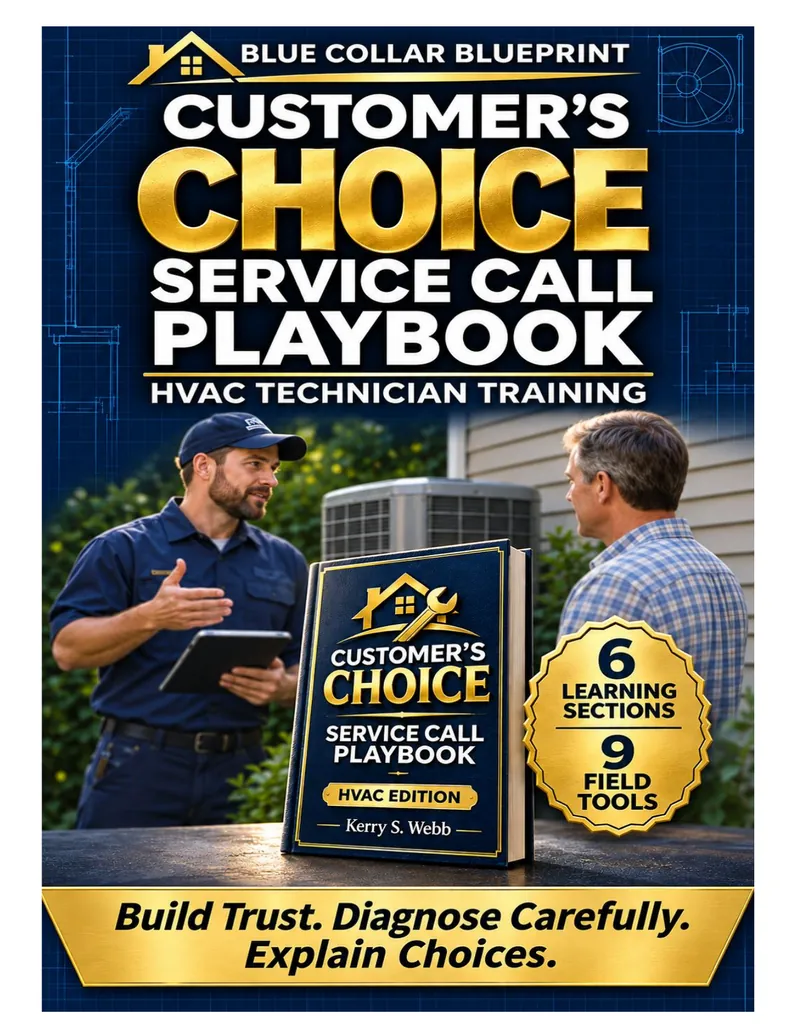
The Customer's CHOICE Service Call Playbook is a 62-page training book for HVAC service technicians. Six sections walk a technician through the whole call, from getting ready in the truck to the care talk at the end, each with sample wording, a partner role-play, judgment questions and a five-call field assignment. Nine field tools at the back help your manager coach it.
The thread through all six sections is permission and plain truth. Tell the customer what the visit costs before it starts, show what you actually found, give honest choices, and get a clear yes on the work and the total price before any repair begins.
Price: $499
Buying online needs JavaScript turned on. You can also order the Customer's CHOICE Service Call Playbook through the contact page.
01 / The problem
Your Technicians Are the Company
The customer never meets you. She meets the technician who knocks on her door, walks through her house, tells her what he found and puts a price in front of her. Whatever she decides about your company, she decides on that visit.
Most technicians were hired because they can find the problem, and that is what they were trained to do. Where a call usually goes wrong is the talking around the work: a fee the customer did not expect, a repair started before she saw the total, an invoice that does not match what she agreed to, a follow-up call nobody owns.
So the service call goes a different way with every technician on your payroll. You cannot hold a standard you have never written down, and you cannot coach a call you did not hear.
02 / What is inside
What Is Inside the Customer's CHOICE Service Call Playbook
Six learning sections, one for each letter of CHOICE, in the order a service call actually runs, followed by nine field tools your technicians and manager use on real jobs.
C, Character and Competence
Getting ready before the knock. A short routine done while safely parked, called RESET, covers the call history, tools and safety, the appointment and fee details, and who can approve work. The technician learns to separate what the record proves from what still needs checking, and when to stop and get a supervisor.
H, Happy Hello
The first conversation at the door. The technician introduces himself, confirms why he is there, agrees on access and protecting the home, and explains what the diagnostic covers and what it costs before it starts. The book treats the greeting as "a conversation, not a performance."
O, Overview and Discovery
Listening before testing. Open questions about when it happens, how often, which rooms, what changed and what the customer most wants fixed, then a summary the customer can correct. What the customer reported, what the technician saw and what is still a guess are written down separately.
I, Inspect Diagnose and Inform
Testing within the agreed scope, recording real measurements, and explaining findings in four plain statements: what I found, what supports it, what it means, what we can do. One supported repair may be enough, and two or three choices are offered only when the differences matter. No repair starts until the customer has approved the work and the total price. A worked thermostat example with sample prices runs through this section and the next two.
C, Complete and Confirm
Doing only the approved work, stopping for new approval if the scope or price changes, checking the result against the original complaint, and showing the customer how it works. The invoice is matched to what was approved, and every open item gets a named owner and a deadline.
E, Educate and Extend Care
Care advice that fits this customer's system, a maintenance plan explained with its real terms as an option and not a must, and an honest review request that never asks for a rating. When the customer says no, the technician stops the pitch. No promises of savings or health benefits the evidence cannot support.
Every section follows the same pattern: the standard, short lessons with sample wording, a partner role-play, five "Check your judgment" questions, and a field assignment of five real calls with two reviewed by the manager. The back of the book holds nine field tools: the CHOICE Call Map with the three checkpoints that cannot be skipped, a Field Call Checklist, a Findings and Decision Record, a Repair Authorization Checkpoint, the CHOICE to CHOOSE Handoff, a Manager Ride Along Review, a Scenario Library for Coaching, a Balanced Service Scorecard, and an Implementation and Readiness Plan. This is a communication and judgment guide, not an equipment repair procedure, and it is meant to be used alongside your own company procedures and the manufacturer's instructions. The answers to the judgment questions are not printed in the book itself. They are in The Customer's CHOICE HVAC Trainer and Instructor Guide, which comes with the book at no extra charge.
Included with this book
Buy the Customer's CHOICE Service Call Playbook and you also get this PDF at no extra charge:
- The Customer's CHOICE HVAC Trainer and Instructor Guide, 43 pages. It contains the answers to the book's "Check your judgment" practice questions.
It has its own download link in your order email and on the thank-you page, beneath the book's.
03 / How a team runs it
How a Service Team Actually Runs It
The book closes with a suggested four-week pilot. Run it with a small group first, adjust it to your staffing and call volume, and decide from what you see whether the team is ready.
-
Fill in your company details first
Before anyone trains, the person who owns the program and a technical lead check the technical wording and set down your own fee and credit rules, maintenance plan terms, escalation contacts, and who owns handoffs and complaints. The book asks for these before use.
-
Week 1, Sections 1 and 2
A trainer teaches getting ready and the greeting. Technicians practice in pairs and get feedback on their role-plays.
-
Week 2, Sections 3 and 4
Discovery and diagnosis. The manager reviews the technicians' findings, the choices they offered and their approval records.
-
Week 3, Sections 5 and 6
Closing the call and care advice. A coordinator checks that handoffs were accepted and promised follow-ups were done.
-
Week 4, the whole call
The manager rides along on full calls, scores them with the ride-along review, looks at the scorecard and asks the technicians what confused them.
-
Decide from evidence, not attendance
The book's suggested bar is a score of at least 3 out of 5 in each stage on two observed calls, with no open gap on approval, safety or checking the work. Then you continue the pilot, revise and repeat it, or roll it out. It is a coaching bar, not a technical qualification.
04 / Why it pays
Honest Calls Are a Money Question
Every disputed invoice, every repair started before the customer saw the price and every callback nobody owned is time and goodwill you are not paid for. Those are exactly the moments this book puts checkpoints around: before the diagnostic, before the repair, and before the technician leaves.
The book's scorecard reflects that. Your manager tracks approval before repair, checks recorded after repair, complete records, related callbacks within 30 days and follow-ups kept on time, alongside repair acceptance and average repair revenue. It warns against targets that reward forced bundles or unnecessary findings. Sales still count. They are just not the only thing on the board.
05 / Who it is for
Who Buys This and Who Uses It
You buy it. Your HVAC service technicians work through it, one section at a time. Your service manager coaches it with the ride-along review, the coaching scenarios and the scorecard.
That split matters, because the most common way a playbook dies is an owner who buys it, agrees with it and puts it in a drawer. This one is written to be handed over. The pilot names a few roles: a program owner, a technical lead, a trainer, a coordinator and a manager. In a smaller shop one person may wear more than one of those hats. If you have no service manager yet, the person you would promote is the person to hand it to.
06 / Pairs with
Where the Service Call Hands Off
When a technician finds a real reason to talk about replacing a system, and the customer wants that conversation, this book does not try to sell it on the spot. It hands off to a CHOOSE2 replacement consultation, with a one-page form that passes along the findings, the repair option and its price, the customer's priorities, and a named owner for the next contact. If the customer says no, no appointment is made.
Replacement conversations that start on a Customer's CHOICE call are handed to the CHOOSE2 Sales Training Playbook, the other side of that handoff.
-
Training program
CSR Booking Excellence Playbook
For the people who answer your phone and book your calls.
-
Scripts and checklists
CSR Call Scripts & CRM Mastery
Call scripts and CRM tasks for the people on your phones.
-
Sales training
CHOOSE2 Sales Training Playbook
For HVAC comfort advisors who run replacement consultations.
-
Sales training
The Elite Sales Closers Playbook
Residential HVAC sales training for experienced comfort advisors.
-
Playbook
The HVAC Service Manager Playbook 4.0
For the person who runs your HVAC service department.
-
Workbook
Business Growth Toolkit
A 90-day planning workbook for owners and their leadership teams.
07 / Questions
Frequently Asked Questions: Customer's CHOICE Service Call Playbook
Which of my people is the Customer's CHOICE Service Call Playbook for?
Your HVAC service technicians, the people running diagnostic and repair calls in customers' homes. The book is written to them. Your service manager uses the ride-along review, the coaching scenarios and the balanced scorecard at the back to coach them and decide when each technician is ready.
Is this a sales program?
No. It teaches a technician to find the real problem, explain it plainly and let the customer decide. The book says useful education "does not require an additional sale." When a customer wants to talk about replacing the system, the technician hands that off to a CHOOSE2 consultation instead of selling it on the call.
Does it make my technicians offer good, better and best on every call?
No. The book says one supported repair may be enough, and two or three choices are used only when the differences are meaningful. Optional items stay separate and clearly optional, and a customer never has to buy a maintenance plan or an add-on to get the repair they need.
Does it teach my technicians how to fix the equipment?
No. It is a guide to how the call is run and explained, not a repair procedure. The book tells technicians to follow the manufacturer's instructions and your company's technical and safety procedures, and it leaves technical qualification with your company.
Are the answers to the judgment questions in the book?
Not in the book itself. Each section ends with five "Check your judgment" questions, and the answers are in The Customer's CHOICE HVAC Trainer and Instructor Guide, a 43-page guide that comes with the book at no extra charge.
What does the Customer's CHOICE Service Call Playbook cost?
$499. It is a PDF download, delivered by email after payment. The book is 62 pages: six learning sections and nine field tools.
Put One Service Call Standard in Every Truck
Six sections, nine field tools and a four-week pilot your service manager can run, in one PDF. Preview the first section free, or add it to your cart.
Price: $499
Buying online needs JavaScript turned on. You can also order the Customer's CHOICE Service Call Playbook through the contact page.
Questions before you buy? Call BGS Strategies on 940-441-3231 or email support@bgsstrategies.com.