

Business Growth Toolkit
Last updated:
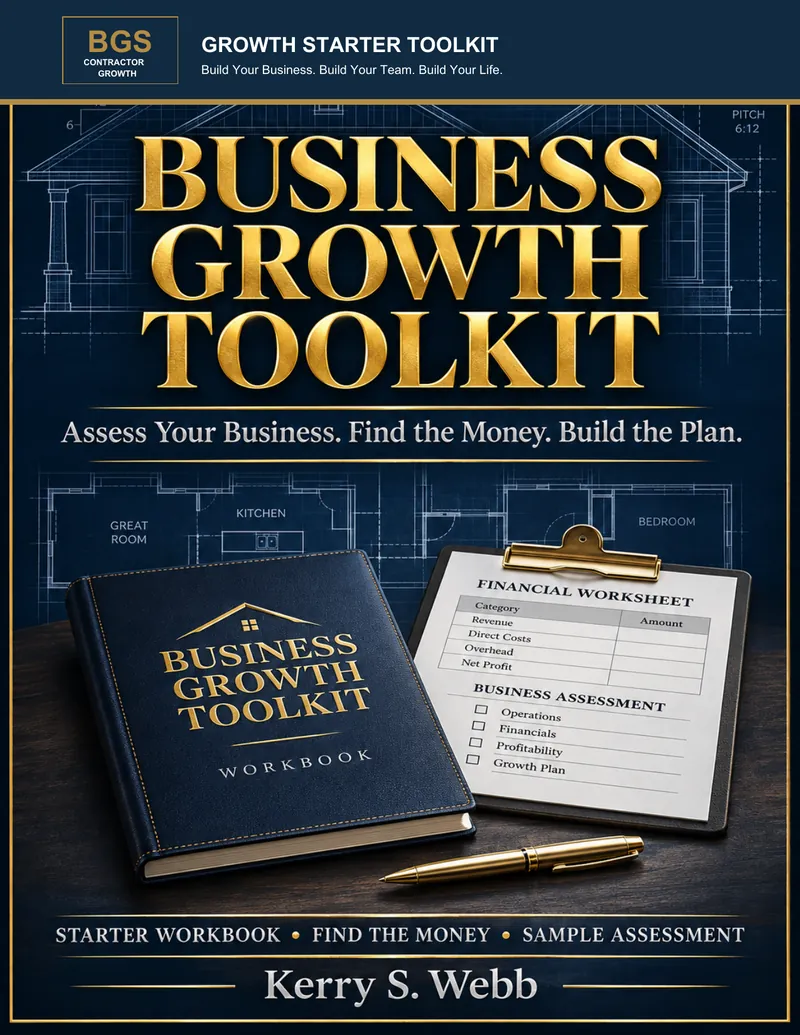
The Business Growth Toolkit is a 90-day planning workbook for contractor owners and their leadership teams. It walks you from your baseline numbers to three chosen priorities, a plan for each one and a weekly scoreboard, across a 13-week cycle. It includes 11 worksheets, working definitions for the numbers, the Find the Money data form and a completed sample assessment.
The words "Sample Assessment" on the cover do not mean you are buying a sample. They refer to a fully worked example inside the book, so you can see an assessment filled in before you build your own.
Price: $399
Buying online needs JavaScript turned on. You can also order the Business Growth Toolkit through the contact page.
01 / The problem
Busy Is Not the Same as Growing
Most owners do not lack ideas. They have twenty of them, half started, and no clear picture of which one would actually move the numbers.
So the year goes by on whatever is loudest that week. Nobody owns the big three, nobody checks the scoreboard on Friday, and twelve weeks later the same problems are sitting in the same place.
This workbook is built around a simple order: start with evidence, pick only three things, give each one an owner, and check it every week.
02 / What is inside
What Is Inside the Business Growth Toolkit
A 32-page workbook in three parts: the planning worksheets, the Find the Money data form, and a completed sample assessment.
Start here
Your first three moves: gather a recent profit-and-loss report, job report and lead report, complete the baseline, and book a weekly review. There is room for the cycle leader, the dates and your first action.
01 Establish your baseline
Record revenue, gross profit, operating profit, qualified leads, completed jobs, average job value and productive hours for one reporting period, with a column for where each number came from. Unknown numbers get marked unknown, not guessed.
02 Find the money
Estimate one opportunity at a time, with the inputs, the calculation, the costs and a small test to check the estimate. The book is plain that these are estimates, not promised results.
03 Choose your top three
Compare opportunities by evidence, impact, effort and team capacity, choose only three for the cycle, and write down what you are deliberately putting off.
04 Priority execution plans (three pages)
One page per priority, each with one accountable owner, one measurable target, a 90-day date, and the actions, owners and due dates to get there.
05 Map the 90-day cycle
Lay the 13 weeks onto your calendar, stage by stage, with a deliverable and an owner for each, and set the recurring review day.
06 Equip the team
Name the skill to improve, describe what good looks like, set the practice and the trainer, and decide how you will confirm the person can do it on the job.
07 Run the weekly rhythm
Monday, choose three outcomes. Midweek, clear blockers. Friday, read the scoreboard. Then the leadership review. Duplicate it every week.
08 Keep a weekly scoreboard
A few KPIs tied to your top three, each with a baseline, target, actual and next action.
09 Coach and solve a problem
Start with an observable gap, separate facts from assumptions, ask the person doing the work, agree a small test and set a follow-up date.
10 Prepare for office hours
Get one clear question ready, with your numbers, what you tried and the specific help you need.
11 Review results and reset
In week 12, record start, target and end for each priority, what worked and what did not, what to keep, stop or change, and who to recognize. Then start the next cycle.
Use the numbers well
Working definitions for revenue, gross margin, operating profit, lead conversion, average job value, productivity and margin opportunity, plus a short rule on keeping estimates separate from measured results.
Your next action and The 7 Step Method
One page that sets out the working sequence: Assess, Find the Money, Build the Plan, Train, Execute, Measure, and Coach & Improve.
Find the Money data form
Six steps covering your company profile, your key numbers, your call, conversion and ticket volumes, a 1-to-5 rating of whether the team can run without you, and your 12-month goals for revenue, net profit and time away.
Sample assessment
A completed assessment for a sample owner, showing his scores, his Find the Money estimates, his top three 90-day priorities with a focus for each, his performance gaps and his leadership ratings. The targets and dollar figures in it are examples to show how the pages work, not results you should expect.
The worksheets are fillable and can be used on screen or in print, and the book suggests saving a fresh copy for each 90-day cycle. The calculations are done by hand. The toolkit works from your own profit-and-loss, job and lead reports; it does not do your bookkeeping or replace your accounting software, and it is not a scored assessment or a promise of results.
03 / How a team runs it
Built to Be Run Over 13 Weeks
The book lays the cycle out week by week. You set the dates; it sets the order.
Weeks 1 and 2, assess and find the money
Pull your reports, fill in the baseline, and estimate the opportunities one at a time. Mark the gaps in your data and give someone the job of closing them.
Weeks 3 and 4, choose three and build the plan
Pick your top three, give each one an owner and a target, and lay the cycle onto the calendar.
Weeks 5 to 11, execute, train and improve
Run the weekly rhythm and the scoreboard every week. Use the training and coaching pages when someone needs a skill or a number slips.
Weeks 12 and 13, review and reset
Compare where each priority started and ended, decide what to keep, stop or change, and choose the next three.
04 / Why it pays
Why It Starts With Evidence
Owners lose money on good-sounding plans that were never checked against the numbers. This workbook makes you write down where every number came from, test an estimate small before you bet on it, and avoid counting the same jobs twice under two different ideas.
Read moreShow less
It is honest about what it is. The estimates are estimates. A change during the cycle is not proof of what caused it. What you get is a disciplined way to decide, act and check, every week, for 13 weeks.
05 / Who it is for
Who Buys This and Who Uses It
The owner buys it and leads the cycle. Choosing the three priorities is an owner's decision.
The rest is built to be shared. Each priority plan names an accountable owner, the training page names a trainer, and the scoreboard has its own owner, so your managers each carry a piece of the plan. The form inside asks about service technicians, install crews, CSRs and dispatchers, service and replacement revenue and maintenance agreements, so it fits a contractor that runs service calls and replacements.
06 / Pairs with
Where the Toolkit Sits Beside the Training Books
The toolkit tells you where the business deserves attention first. The numbers it asks you to track include inbound call booking, service call conversion, average service ticket and replacement conversion, and the training books are where your team works on those jobs.
For the calls your office books, see the CSR Booking Excellence Playbook; for the service call itself, the Customer's CHOICE Service Call Playbook; and for replacement sales, the CHOOSE2 Sales Training Playbook.
-
Training program
CSR Booking Excellence Playbook
For the people who answer your phone and book your calls.
-
Scripts and checklists
CSR Call Scripts & CRM Mastery
Call scripts and CRM tasks for the people on your phones.
-
Training book
Customer's CHOICE Service Call Playbook
For HVAC service technicians, from the truck to the follow-up.
-
Sales training
CHOOSE2 Sales Training Playbook
For HVAC comfort advisors who run replacement consultations.
-
Sales training
The Elite Sales Closers Playbook
Residential HVAC sales training for experienced comfort advisors.
-
Playbook
The HVAC Service Manager Playbook 4.0
For the person who runs your HVAC service department.
07 / Questions
Frequently Asked Questions: Business Growth Toolkit
What does the Business Growth Toolkit cost?
$399. It is a PDF download, delivered by email after payment. It is a 32-page fillable workbook you can use on screen or print.
The cover says "Sample Assessment." Am I buying a sample?
No. You get the full workbook. "Sample Assessment" is the name of the completed example at the back of the book, so you can see an assessment filled in from start to finish.
Are the Skool community and the supporting modules included?
No. The Business Growth Toolkit is a do-it-yourself book that stands on its own. The Skool community and the supporting modules the book mentions are separate from the book and are not included with it.
Do I need an accountant to use this?
No. You need a recent profit-and-loss report, a job report and a lead report. The book gives plain working definitions for each number and asks you to line them up with your own reports. If a number is unknown, you mark it unknown and assign someone to find it.
Does this replace my accounting software?
No. Your accounting software records what happened. This workbook reads from those reports to help you choose three priorities, plan them and check them every week.
Can my managers use it?
Yes. Each priority plan has one accountable owner, the training page has a trainer, and the weekly scoreboard has an owner. The owner leads the cycle; the managers run their pieces of it.
Are the targets and dollar figures in the book what I should expect?
No. The book prints example targets and a worked sample to show how the pages work. It says plainly that its estimates are not promised results. Your own numbers come from your own reports.
08 / Get the workbook
Start Your Next 90 Days With a Plan
Pick three priorities, give each one an owner, and check the scoreboard every week. The workbook gives you the pages to do it.
Price: $399
Buying online needs JavaScript turned on. You can also order the Business Growth Toolkit through the contact page.
Preview the Business Growth Toolkit (sample pages, PDF)
Questions before you buy? Call BGS Strategies on 940-441-3231 or email support@bgsstrategies.com.